
The Art Issue: What Kinds of Selves Live Inside an Artist’s Studio?
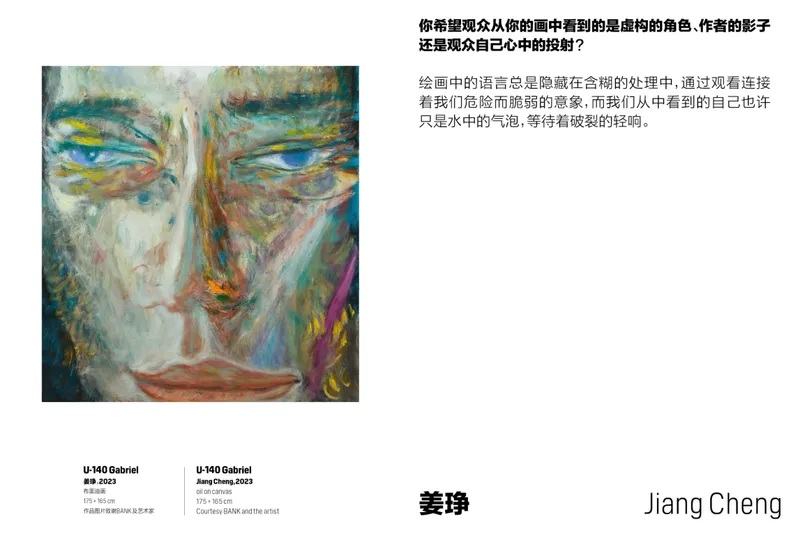
When standing before Jiang Cheng’s portraits, one is first drawn to the doubled eyes. They resemble traces of a sketch, multiple photographic exposures, or a dangerous sense of vertigo, preserving something still active within an otherwise suspended state.
They call to mind Antonin Artaud’s The Theater and Its Double: if theater is the double of life, then life is the true double of theater. Artaud’s “Theater of Cruelty” sought to break through the dominance of the literary script, replacing dialogue-driven narrative with nonverbal means, using concrete form to capture abstract ideas, and employing sensory shock to make audiences experience a spiritual tremor.
Jiang Cheng describes the moment of touching the essence of art as a “shiver.” When speaking about his work, he almost inevitably brings up theater. He takes theatrical figures as inspiration for his portraits, has titled a solo exhibition after a play by Peter Handke, and has even simulated theatrical space within the gallery. Most strikingly, he paints the possibility of theater beyond language: a soulful sensation of being inside a theater, fleeting moments of resonance detached from any specific narrative, leaving behind only emotion once time has dissipated.
The figures’ faces are enlarged enough to envelop the viewer, and the dramatic structure comes into being the moment the audience meets their gaze. Just as in an immersive environment without a fixed stage, where the boundary between actor and audience dissolves and theater becomes a collectively participated “event,” Jiang Cheng makes the viewer part of the “plot” as well, opening up an endless exchange of gazes between the painter, the painted figure, and the beholder. In a single glance, it already becomes eternal.
From March 25 to 29, Jiang Cheng’s solo presentation will be presented by BANK at Art Basel Hong Kong 2026.
W in Conversation with Jiang Cheng (“J” below)
W: You worked in your Beijing studio for many years, and then moved your studio to Shanghai in 2022. What prompted that move?
J: In Beijing, my studio was converted from a factory building, and later the entire compound was demolished. In 2022, I moved to Shanghai. When I found my current studio, I felt the windows, the space, and the light were all just right, so I settled there.
W: How do you understand the meaning of the studio as a space for you?
J: The studio is a space for painting, something like a shelter. In life, everyday details, habits, and emotions spread into this space. It is an extension of the body. When an artist first arrives in a new space to paint, there is still a certain unfamiliarity between the artist and the space, and it may take some time to adjust before entering the right state. But after staying in it long enough, the boundary between the artist and the space disappears. The space becomes part of the artist’s body, and in that condition, making work becomes as natural as breathing.
W: The “U” series has been your main body of work in recent years. Why is this series called “U”?
J: The “U” series has been the main thread of my work from 2018 up to the present. “U” can be seen as an abbreviation of the pronoun “You.” In the act of making, it refers to the canvas positioned opposite the artist and bearing the traces of creation. Conceptually, it points toward a more primordial world confronted by the “I” outside self-consciousness.
W: You have said that your work always revolves around the structure generated by looking, and you have described your practice as a kind of shiver. How do these ideas connect to painting today?
J: “Art happens between waiting and shivering, in that instant of being startled.” I once described my work that way, and I still believe that description remains meaningful for painting. In painting, the image is always uncertain. Sometimes you feel that, for one moment, you have grasped the image and depicted it, and then the painting slips through your fingers and disappears. Even when we look at a painting, we cannot discover its full picture or some supposed truth behind it simply through looking at the image, because looking cannot be completed independently. Looking produces structure, creates identity, and creates the distinctions between you, me, and him.
W: Your work always revolves around portraiture. How are these figures created? Why do some faces seem layered, as if several faces were superimposed?
J: People often ask me how the images in my paintings are made. I cannot really say, other than to say that at the beginning I wanted to paint a face, and then this is what happened.
Most of my paintings are prompted by a gesture, an emotion, or an intention. A particular emotion is often followed closely by an image, and when my consciousness is drawn in by looking and my body and movements become slowed, a shiver occurs. What happens on the canvas cannot be taken back, only pushed forward. At that point I may turn the canvas in another direction, in order to interrupt the image’s pull over me, and continue wandering across the surface. That is also why the viewer sees so many eyes in the image.
In this situation, “portrait painting” becomes something extremely obscure. On one side, I do not provide the painted figure’s background in advance; on the other, the figure appears and disappears within the quicksand of oil paint, ambiguous and evasive. Between the two lies a zone that is not only worth exploring, but must be explored. Between you and me, body and canvas, identity and image, there are obstacles everywhere, and the image remains elusive. But it is precisely through these processes that a language is born.
W: Do these portraits correspond to specific people or characters? What is your relationship to them? How are they named?
J: In the end, I always finish by naming the figures U-1, U-2, U-3, and so on. There are two images that have continuously shaped my work over the last two years, and later I named them Michael and Gabriel — faces that are both human and angelic. It is an idea that is both beautiful and dangerous. More recently, another interesting image has emerged: I began making faces lit from a light source below, with the figure caught in a state of surprise. He seems to have discovered something, perhaps the viewer, perhaps a hallucination produced by being seen. Creating figures, or characters, places me in a very particular position. At first I think he may be part of me, but later I realize that what has emerged is a flesh-and-blood person, someone with his own will and emotions. He is wary of my gaze, even resistant to it. I am not welcome by him.
W: What do you hope viewers will see in your paintings: fictional characters, the shadow of the author, or their own inner projections?
J: The language in painting is always hidden within ambiguity. Through looking, it connects our dangerous and fragile images. And what we see of ourselves within it may be nothing more than bubbles in water, waiting for the faint sound of bursting.

