
ARC Review | The Eco-Spiritual Allegory in Ocean Cage
Author / Zuqin Ou
Originally published on ArtReview Chinese Edition, 2026 March
Ancestor (Moyang)
"Beyond determination and collective reciprocity, what has enabled humanity to survive and reproduce through one perilous chapter of history after another is also a spiritual bond with all things. That, too, is the enduring path of ecological continuity, because survival itself is coexistence."
Ocean Cage
Chen Tianzhuo, director; Siko Setyanto, choreographer; music by Kadapat and Nova Ruth; co-produced by partner in crime and Chen Tianzhuo.
Premiered at HAU2, Berlin, in 2024; toured to the Shanghai Dramatic Arts Centre in October 2025.
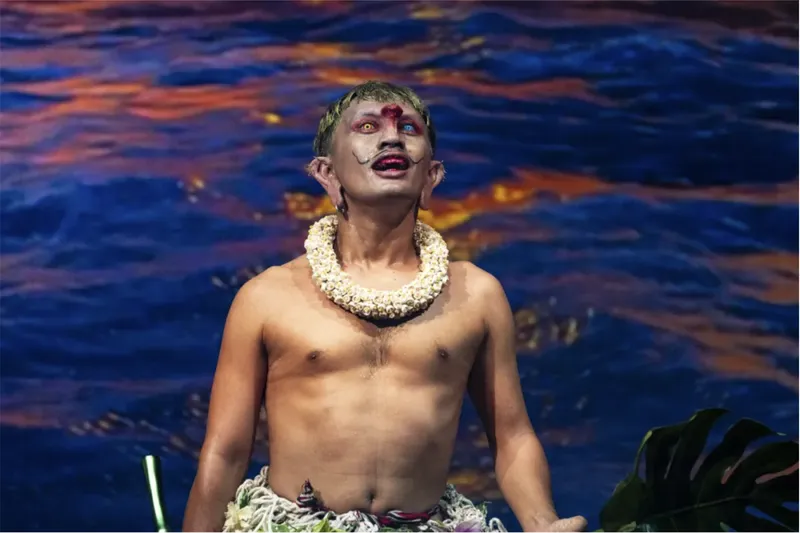
It begins with smell. A dense fishiness mixed with damp salt hits the body first. Then comes the light, as though one had entered the sunlit zone beneath the sea, murky yet suffused with radiance. Then the sound of water. Two massive jujube-red ceramic jars stand on either side of a giant screen, as living water pours from elevated pipes into the vessels, conjuring an amphibious atmosphere with the aura of tribal ruins. Stranded boats, tropical fruits and flowers, soft sand, and enormous fish bones are scattered throughout, flickering in and out of view under uneven illumination. On first entering, one truly feels as if one has stepped onto an island.
But this is no ordinary “island.” The neon violet light on the giant screen shifts into images of an Indigenous community, recounting the rituals, worship, voyages, and whaling history of Lamalera, the last small fishing village in the world to sustain itself through whale hunting. The footage moves from black-and-white anthropological documentary material to color images of contemporary daily life in Lamalera, eventually focusing on a “mysterious figure” wearing a ritual mask-like headdress, bare-chested, and dressed in red tribal attire. This figure, linking past and present, is performed by the Indonesian dancer and choreographer Siko Setyanto. He rides a motorcycle, blowing a whistle, speeding along the shoreline. At that exact moment, both the screen and the stage lights go dark. The whistle sounds from the rear of the stage. The mysterious figure roars out of the darkness on the motorcycle, shouting loudly as he disperses the neatly assembled crowd at center stage. And so the two-hour performance begins in a manner that is absurd, disorderly, and impossible to ignore.

