
Review | Patty Chang and David Kelley: ArtCenter Exhibitions
Author / Vanessa Holyoak
Originally published on ARTFORUM March 2026 VOL. 64, NO. 7
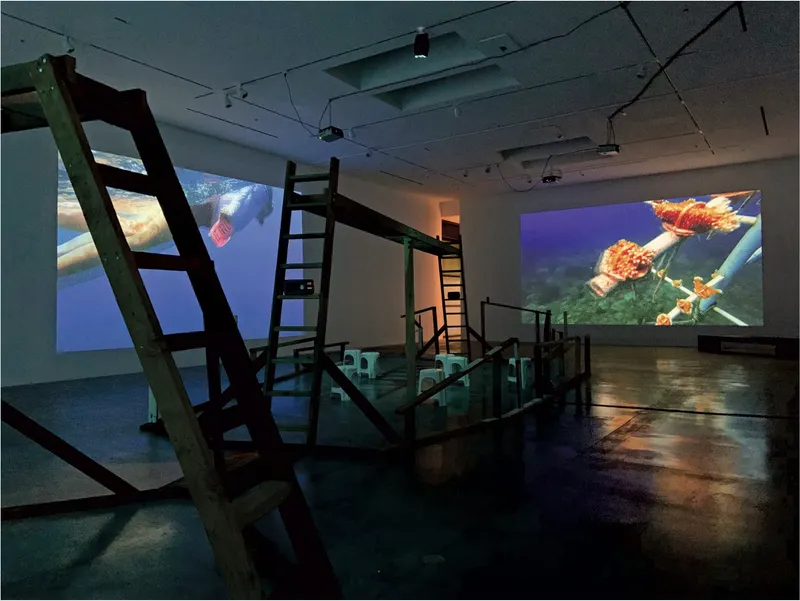
The deep ocean was the main protagonist of Patty Chang and David Kelley’s exhibition “Our Abyssal Kin” at ArtCenter, emerging as a site in which human and ecological narratives—and struggles for justice—become inseparable. Unfolding across three collaborative installations that probe our extractive relationship to the sea over geological and human timescales, the show offered an expansive critique of the exploitative history and ongoing practice of deep-sea mining. It centered on a four-channel video installation, Stray Dog Hydrophobia, 2024, which combines sequences filmed at the International Seabed Authority (ISA) in Kingston, Jamaica, and its surrounding coastal environs with 3D animations that introduce nonhuman perspectives into conversations around the legislation of the ocean floor.
Much of Stray Dog Hydrophobia, projected onto the four walls of the central gallery, concerns the ISA, the entity responsible for regulating how countries and corporations mine the ocean floor. The video itself builds on this intersection between human detritus and embodied ecological perspectives, tracing legacies of colonial capitalist trade in the Caribbean and beyond through imagery that oscillates between documentary, absurdist, and poetic registers. Clandestine iPhone shots of ISA meetings are juxtaposed with encounters with figures such as Indigenous environmental activist Soloman Pili Kaho’Ohalahala, “Uncle Sol,” who speaks eloquently about Native Hawaiian understandings of the ocean as an ancestral site of sacred creation—an intangible cultural heritage elided by the ISA’s erasures of Indigenous and ecological perspectives. Other sequences use 3D animation to imaginatively “sink” the corporate bodies and desks of the ISA meeting room to the ocean floor, where they are overtaken by drifting marine snow and coral-like overgrowth, underscoring the absurdity of ignoring nonhuman perspectives in discussing the regulation of ocean resources. The rare-earth minerals, such as polymetallic nodules—formed over millions of years through interactions of organic matter and mineral substrate—extracted from the ocean’s depths are used to manufacture batteries and screens. This connection between matter and media undergirds Chang and Kelley’s project. While Chang began her career as a body-based performance artist in the late 1990s, her more recent collaborative work with Kelley has primarily employed video, a medium that relies on such materials excavated from the deep.
The titular Our Abyssal Kin, 2024, is a kinetic installation of spinning found crockery, onto which the artists painted fragments from Adrienne Rich’s poetry and texts about the 1872 HMS Challenger expedition, one of the first to attempt to map the ocean bottom. It was exhibited alongside works from the “Chakra Sculptures”series, an ensemble of taxidermied deep-sea specimens from the Scripps Institution of Oceanography in La Jolla, California, accompanied by miscellaneous shipwrecked and eBay-sourced porcelain fragments displayed in glass jars and terrariums. Together, the works exposed the colonial legacies of oceanic resource extraction, scrutinizing the impulse to bring unseen ecologies to light while revealing the interspecies narratives embedded in seaborne materials. The “Chakra Sculptures,” in particular, do so by interrogating the Western fixation on objectifying and “taming” the unknown, pointing toward the unsettling impulse to bring to light life-forms that evolved in complete oceanic darkness, impenetrable to human vision.
Throughout the exhibition, jarring apparitions of deep-sea materials and life-forms alongside images of the detached human behavior that oversees such nonhuman life—from ISA meetings to HMS Challenger logs, which the artists situate in the context of British colonialism and its afterlives—revealed the interconnected violence of extractive oceanic practices, from the Middle Passage to contemporary mineral harvesting. But beyond this salient critique, Stray Dogand its associated installations pushed further to highlight the alternative lifeways that persist in resistance to such legacies, from Uncle Sol’s chants toward the possibility of cross-species oceanic relations to the sounds of drumming performed by a historic Jamaican Maroon community in defiance of their exploitation. Such performances mirrored Chang and Kelley’s approach to the oceanic, revealing it as a gathering place in which biological, mineral, human, and nonhuman histories collide.
Related artists
-
David Kelley 大卫·凯利
-

Patty Chang 张怡
